How to get Google AdSense and AdMob Approval with a Privacy Policy
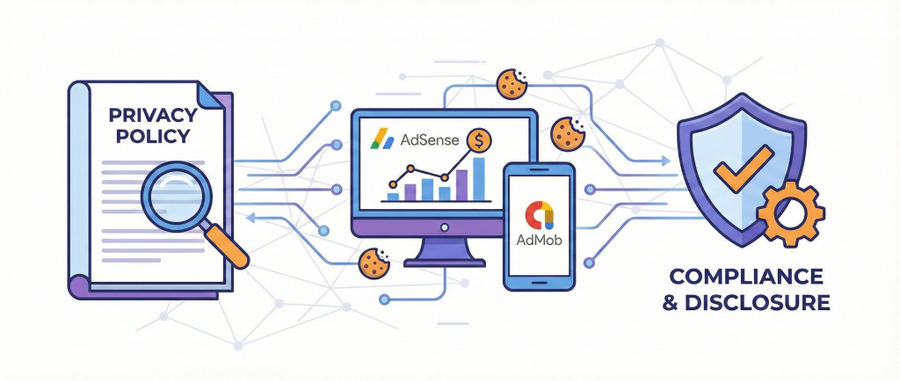
1. What specific disclosures must my AdSense Privacy Policy include regarding cookies and tracking technology?
The foundation of AdSense compliance rests upon precise and comprehensive disclosure regarding the use of tracking technologies, primarily cookies. The Privacy Policy must explicitly include mandatory wording that addresses Google's use of personalized advertising.
Mandatory Disclosure of Third-Party Vendor Usage
The policy is required to state clearly that third-party vendors, with specific inclusion of Google, employ cookies to serve advertisements. A critical component of this disclosure is the explanation that these ads are based on a user's prior visits to the publisher's website or other websites on the Internet. This specific phrasing is non-negotiable, as it proves that the publisher is transparently disclosing Google's cross-site profiling capabilities to their users. By requiring the publisher to state this specific mechanism, Google effectively manages its own risk by transferring the liability for this specific tracking disclosure to the entity placing the ad code. Publishers who use boilerplate templates that omit this specific description of personalized ad targeting risk immediate rejection.
Significance of Google's Advertising Cookie
Publishers must notify users that Google's utilization of the advertising cookie enables Google and its partners to serve ads that are customized based on the user's observed visitation patterns across the web. This detail is essential for fulfilling transparency requirements concerning user profiling activities, which underpin modern ad monetization. Furthermore, when a user first interacts with the website, they must be immediately informed that cookies are in use, and this notice must link directly to a page that details the types of cookies used, identifies the specific third parties utilizing them, and explains the purposes these cookies serve. The requirement for this technical detail, specifically mentioning cross-site tracking, underscores that compliance is highly technical, demanding precision that simple templates cannot guarantee.
LimePolicy is designed to guarantee the inclusion of this required Google clause immediately upon identifying AdSense usage in the policy configuration phase, eliminating the risk of accidental omission.
2. How can developers and bloggers generate a compliant policy that covers AdSense, AdMob in minutes?
The primary challenge for developers and bloggers is overcoming the time-accuracy paradox: they need a policy immediately for launch, but it must be legally precise to avoid rejection and future liability.
The Need for Speed and Accuracy
Publishers require a solution that delivers operational velocity, often needing policy approval within hours to meet launch deadlines, combined with guaranteed legal precision to ensure adherence to specific regulations (GDPR, CCPA) and mandatory Google clauses. Researching and drafting these policies manually, or relying on outdated free templates, is unsustainable and error-prone.
LimePolicy’s 4-Step Compliance Workflow
LimePolicy provides a structured, rapid workflow that translates complex legal documentation into an accessible process, ensuring the inclusion of all necessary clauses:
Visit Lime Policy: The publisher initiates the streamlined compliance workflow.
Fill in Basic Details: The user defines the property type (Website, App, or both ), identifies their core jurisdiction, and describes basic business practices and data collection methods.
Select Necessary Clauses: This is the pivotal expert action point. The publisher selects the clauses relevant to their services. Crucially, the platform ensures the inclusion of required Google AdSense and AdMob disclosures, alongside the necessary global regulatory overlays (GDPR, CCPA, etc.). The system prompts the publisher to confirm the use of services that mandate highly specific legal language, ensuring all required disclosures are automatically integrated and precisely worded.
Download and Publish: The custom-generated policy is delivered instantly. The publisher can then seamlessly deploy the policy via embed code, link, or formatted text, ready for immediate publication and submission to Google for approval.
This SaaS model inherently provides crucial ongoing compliance value. As Google updates its Publisher Policies or new US state laws emerge, a policy generated by a service like LimePolicy can be continuously monitored and automatically updated, proactively protecting the publisher’s revenue stream from subsequent compliance failures.
3. How do I structure the opt-out mechanisms required by Google’s personalized advertising policies?
Compliance with personalized advertising policies demands that the publisher grant users a clear, accessible, and multi-layered mechanism for opting out of interest-based tracking. This is a fundamental transparency requirement enforced by Google.
Direct Opt-Out Link Requirements
The Privacy Policy must provide clear avenues for users to exercise control over personalized advertising. The primary mandated method involves directing users to Google’s own centralized Ads Settings control panel. This link ensures users can manage their preferences directly within the Google advertising ecosystem.
Industry Standard Alternatives
In addition to Google’s specific tool, publishers must also direct users to broader, industry-standard opt-out platforms. Specifically, the policy must reference the ability for users to opt out of certain third-party vendors' personalized advertising cookie usage by visiting the comprehensive resource provided at www.aboutads.info. The necessity of including both the Google-specific mechanism and the industry-wide platform demonstrates Google's enforcement of comprehensive transparency and global best practices regarding consumer choice. This multi-layered approach strengthens the policy’s legal defensibility and is a necessary sign of adherence to ad-tech standards.
Vendor-Specific Opt-Outs
The disclosure responsibility extends beyond Google. For every identified third-party vendor or ad network that is serving ads on the property—often introduced via ad network mediation or sub-syndication—the policy must provide links to their respective websites. It must inform users that they may visit these vendor sites to opt out of personalized advertising, provided that the vendor or network offers that capability. This creates a substantial ongoing maintenance burden; every time an ad network is added, the policy must be meticulously updated. This logistical challenge highlights the practical utility of an automated SaaS model like LimePolicy, which streamlines the selection and disclosure of various common ad partners.
4. Beyond AdSense, what are the mandatory policy requirements for Google AdMob app monetization?
AdMob, Google’s platform for mobile application monetization, introduces unique and more stringent compliance requirements compared to traditional website-based AdSense.
SDK Usage and Data Collection Disclosure
Mobile developers must explicitly disclose to users that personal information is collected, shared, and utilized as a direct consequence of implementing the Google Mobile Ads SDK. Mobile environments involve the collection of highly sensitive data, including mobile identifiers and device information. Consequently, the legal risk is elevated. Publishers using AdMob must update their Privacy Policy to reflect the specific usage of the SDK for serving personalized (or interest-based) advertising.
Dual Platform Compliance
AdMob publishers must satisfy a layered set of requirements: Google’s Publisher Policies, international privacy laws, and the specific mandates set forth by mobile application distribution platforms, namely the Apple App Store and Google Play. Both major app stores require a policy or privacy notice if the mobile app employs an advertising service that collects personal user information, such as AdMob.
Legal Proactivity Required
A notable divergence in AdMob compliance is Google's stance on prescriptive language. Google explicitly states that it is "unable to suggest specific privacy policy language," citing the variation in publisher pages and legal requirements across different countries. This non-prescriptive approach forces the entire responsibility onto the developer to ensure their policy is legally sound for their specific geographic target and mobile platform. This absence of Google-provided boilerplate language emphasizes the need for expert drafting, reinforcing the strategic value of a generator designed to address these complex, region-specific requirements. The swift generation offered by LimePolicy (Step 1 allows selection of 'App option') directly addresses the time-sensitive nature of policy approval necessary for app launch and monetization
5. Where should the Privacy Policy link be conspicuously placed on a website (AdSense) or within an app (AdMob)?
Proper placement is a practical extension of the transparency mandate. If the policy cannot be easily located, it fails the "conspicuous placement" requirement, leading to policy-based rejection.
AdSense Conspicuous Placement
For websites, the Privacy Policy link must be simple for both users and Google reviewers to find. The standard, compliant placement involves a permanent, clearly labeled link (e.g., "Privacy Policy," "Privacy Notice," or "Privacy") consistently located in the website’s footer, ensuring accessibility from every page. A lack of important pages or site navigation issues are common reasons for AdSense rejection. If a reviewer must hunt for the policy, it suggests an intention to meet the letter of the law without adhering to the spirit of transparency, directly resulting in a failure based on user experience quality.
AdMob Dual Placement Requirement
Mobile apps carry a stricter dual-placement requirement for the policy:
In-App Access: The full policy must be accessible from within the application interface itself, typically via a dedicated link found in a settings menu, legal section, or "About" screen.
Store Listing Visibility: The policy’s URL must be prominently linked within the app’s description or listing page on the relevant mobile app stores (Google Play, Apple App Store).
Any delays in drafting and publishing the policy directly impede the app launch timeline, as the app cannot be approved for store distribution or AdMob monetization without this accessible, final document. LimePolicy provides specific deployment guidance and embedding options to ensure correct placement, mitigating placement-based rejections effectively.
6. What specific data points must my policy list as "collected" or "shared" due to using AdSense/AdMob?
Modern privacy laws require policies to move beyond generic statements about "data collection." The publisher must enumerate the granular categories of personal data collected, stored, and shared with third parties due to the use of ad platforms.
Detailed Data Enumeration
The enumeration must cover technical identifiers essential for personalized advertising. Key categories include:
IP addresses and location data.
Cookie data and other web tracking artifacts.
Mobile advertising identifiers (e.g., IDFA or Android Ad ID).
Device and operating system information.
Detailed user behavior and site/app interaction patterns.
Inferred demographic or interest data used for ad targeting.
Failure to specify the type of personal data collected, especially mobile identifiers that are central to AdMob functionality, is a significant indicator of a non-compliant policy. A simple, generic template often misses these technical specifics.
Purpose Justification
Crucially, for each category of data listed, the policy must define the explicit purpose of collection. When using AdSense or AdMob, the primary purpose is usually defined as serving, measuring, and optimizing personalized advertisements. LimePolicy’s structured questionnaire (Step 2) ensures that the publisher systematically checks off every relevant data type collected by the property, guaranteeing that the generated policy is comprehensive and adheres to the specificity required by global data protection regimes.